
Car Trip Planner
Planning a road trip means balancing distance, driving time, breaks and budget. List the legs of your journey with their distances, set your average speed, how long you like to drive between breaks and how many hours a day you want at the wheel, and the planner builds a day-by-day itinerary with arrival times, fuel or charging cost and what each person owes.
- Free to use
- No sign-up
- Runs in your browser
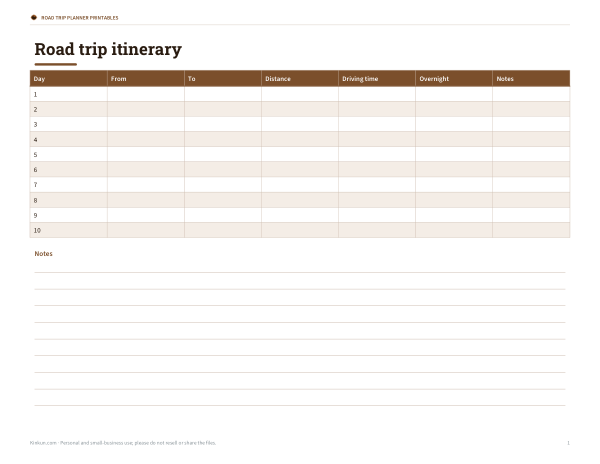
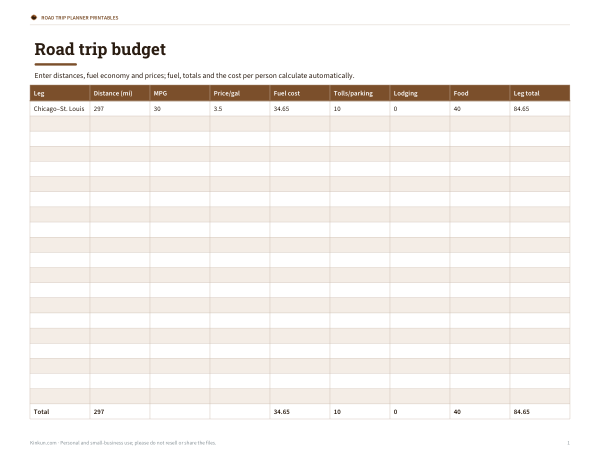
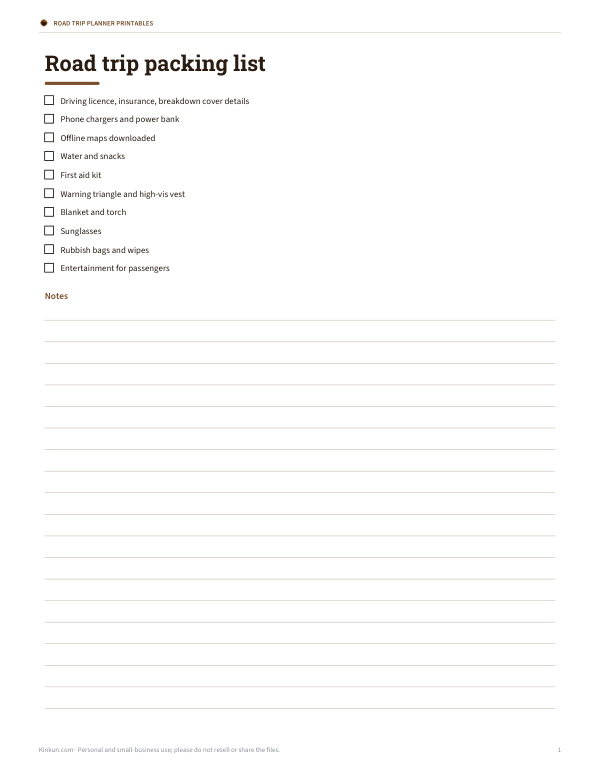
Road trip planner
Road Trip Planner Printables
Printable road trip kit: itinerary planner, Excel trip budget with fuel and cost split, packing list, car pre-trip checklist and a kids’ road trip bingo.
- Itinerary (PDF/DOCX)
- Trip budget (XLSX)
- Packing list (PDF, DOCX)
- Car check (PDF, DOCX)
- Road trip bingo (PDF)
Formats: PDF, DOCX, XLSX. Instant download after payment (link valid 72 hours, up to 5 downloads). AI-assisted: the templates were drafted with AI help and reviewed and laid out before publishing.
$3.00 USD, one-time 5 files · about $0.60 each
- Instant download
- 7-day refund
- Secure checkout by Stripe
7-day money-back guarantee. Full refund within 7 days of purchase, even after you download.
Free sample: Car Pre Trip Check (PDF, 50 KB)
Full refund within 7 days — see the refund policy and license.
Free printables
Single sheets you can print right now, no sign-up. The full pack adds every sheet in one download plus the editable files.
 Printable Car Pre-Trip Check
 Printable Road Trip Bingo
How the planner works
- You enter the start and each stop with the distance to it from the previous stop — from a map app, a road atlas or a route planner.
- Driving time for each leg is distance ÷ average speed.
- A break is added each time you reach your “break every” interval.
- When you reach your daily driving limit, the planner adds an overnight stop and restarts the next morning at your chosen start time; it also suggests stopping at a destination once you have driven most of the day.
- Fuel or electricity is distance × consumption, and cost is split between the people sharing.
Distances aren’t looked up automatically, so the planner works offline and your route stays private.
Choosing an average speed
Your average speed over a whole trip is lower than the speed limit because of towns, traffic, road works and junctions. On motorways and interstates many drivers average around 55–60 mph (90–100 km/h) including slowdowns; on country roads 35–45 mph (55–70 km/h) is more realistic, and less in mountains. Check the time a map app estimates for one leg and adjust your average speed until the planner matches it.
Breaks and driving hours
Road safety organisations commonly advise a break of at least 15 minutes every two hours of driving, and fatigue is a major cause of serious crashes. Share the driving if you can, avoid driving during the hours you would normally be asleep, and stop if you feel drowsy — caffeine and a short nap help only briefly. Professional drivers have legal limits on daily driving hours; for a holiday, many people find 6–8 hours a day enough.
Worked example
Three friends drive Chicago to Denver via St. Louis and Kansas City: 297 + 248 + 606 = 1,151 miles. At an average of 55 mph that is about 20.9 hours of driving. With a 15-minute break every 2 hours and a limit of 8 hours a day, the planner suggests stopping overnight in St. Louis, because the 4.5-hour leg to Kansas City won’t fit in the rest of the day. On day two it drives through Kansas City and adds a second overnight stop partway along the 606-mile leg to Denver, arriving on the third day. A car doing 30 mpg uses about 38.4 US gallons; at $3.50 a gallon that is about $134, plus $25 of tolls and parking — roughly $53 each. Tailpipe CO₂ is about 341 kg.
Fuel and charging
| Vehicle | What to enter | Typical values |
|---|---|---|
| Petrol / gasoline | mpg (US) or L/100 km | 25–40 mpg; 6–9 L/100 km |
| Diesel | mpg (US) or L/100 km | 30–45 mpg; 5–7 L/100 km |
| Electric | miles per kWh or kWh/100 km | 3–4 mi/kWh; 15–22 kWh/100 km |
Real-world economy on a loaded car at motorway speeds is often worse than the official figure. For electric cars, rapid-charger prices are usually much higher than home charging, and cold weather reduces range; plan charging stops at 10–80% for the fastest charging.
CO₂ estimate
The planner uses the US Environmental Protection Agency’s figures of about 8.89 kg of CO₂ from burning a US gallon of gasoline and 10.18 kg from a gallon of diesel. It shows tailpipe emissions only; electric cars have no tailpipe emissions, but the electricity’s emissions depend on how it is generated.
Road trip checklist
- Check tyres (pressure and tread), oil, coolant, screen wash and lights.
- Download offline maps in case you lose signal.
- Pack water, snacks, a phone charger, a first aid kit and a warning triangle.
- Check breakdown cover and insurance, especially abroad.
- Book overnight stops in busy seasons.
- Plan fun stops — viewpoints, parks and places to stretch.
Planning around daylight and weather
Driving in daylight is easier and safer on unfamiliar roads, especially in rural areas and mountains. In winter, check road conditions and closures before each day’s drive and carry warm clothing, water and a blanket. Allow extra time for summer holiday traffic near cities and popular destinations.
Splitting costs fairly
The simplest split divides fuel, tolls and parking equally among everyone in the car. If the car’s owner is providing the vehicle, some groups add a per-mile allowance for wear and tear, or the owner pays less. Agree before you set off, and keep receipts in one place — the CSV download makes it easy to share the plan and costs with the group.
Frequently asked questions
How do I plan a road trip?
List your stops and distances, set your speed, breaks and daily limit, and let the planner schedule the days.
How many hours should I drive per day?
Many people find 6–8 hours comfortable, with a 15-minute break every 2 hours.
How is fuel cost calculated?
Distance ÷ mpg × price per gallon, or distance × L/100 km ÷ 100 × price per litre.
Does it work for electric cars?
Yes, enter efficiency and electricity price.
Does it look up distances?
No — enter them from a map; this keeps the planner private and offline.
Can I split the cost?
Yes, it shows the cost per person.
How much time should I add for traffic?
Many drivers add 10–20% to journey times near cities or at busy holiday periods.
Can I plan an electric car road trip?
Yes — choose Electric and enter efficiency and charging price; plan charging stops separately.
Does it include time for meals?
Add longer breaks or extra legs for meal stops.